What is EPG? A Brief Look at the Health Food Industry's Latest Special Ingredient
Daniel Curtis - Dietitians of Canada Student Representative - St. Francis Xavier University
If you enjoy protein bars, or if you watch content from fitness or nutrition influencers, then you have likely heard of David: the California-based protein bar company, famous for its high protein-to-calorie ratio, with their “Gold” bars consisting of 150 calories and 28 grams of protein. The success of this product is contributed to an ingredient called esterified propoxylated glycerol, better known as EPG, a plant-based fat substitute that has only 0.7 calories per gram, as opposed to 9 calories per gram with fat. The food technology firm Epogee, which manufactures EPG, has been bought out by David; meaning that David pretty much has a monopoly over it, and they have recently begun selling the fat substitute out to other food manufacturers. This is said to be likely to the way for many new diet foods to come out. In this post I will be looking at the background of EPG, the most notable research that has been done on its safety, and what this means in our time of diet culture and protein obsession.
Though it has been only this prominent within the last few years, its origins of EPG date back to the 1980s, when the ARCO Chemical Company originally developed it. One early US patent, now expired, dates back to July of 1986 describing EPG compounds as “non-digestible, low-calorie fat substitutes”. The many patents that followed focused on making and using EPG at a commercial scale. However, this technology would sit somewhat dormant for years until CEO David Rowe and his food tech startup Choco Finesse LLC would use it so develop their own formulas to produce and use EPG at a commercial scale, and they would later change their name to Epogee. They began selling it to food manufacturers for a variety of products ranging from ice cream to baked goods, to plant based meat alternatives. One of those manufacturers was David, a protein bar company owned by RXBAR creator Peter Rahal. They began using EPG in their bars and the company expanded rapidly, reaching over 3000 retail locations across the US and according to Rahal, using roughly 90% of Epogee’s supply. Due to this expansion, David was able to buy out Epogee for $75 million in May 2025 and allegedly, stopped selling EPG to companies that previously used it, leading to a lawsuit the following month where the court has found no wrongdoing on behalf of Rahal. Earlier this year, David began stating plans to start selling EPG to other companies again, which means in the near future we will be seeing many products boasting excellent flavour for exceptionally low calories. Obviously, along with these claims there will be a lot of debate on the safety of these products, luckily there is a lot of research done on EPG which we will now take a quick look at.
This paragraph is essentially gonna be a rough annotation of a series of articles on the safety of EPG done by the journal of Regulatory Toxicology and Pharmacology in 2014, I highly recommend you check it out for further reading if you are interested. Firstly, they go over the way that EPGs are produced: fats/oils are split into glycerol and fatty acids, then propylene glycol units are inserted on the glycerol causing an esterification reaction with the fatty acids, producing EPG. The propylene glycol is how EPG works, its a-methyl group impairs normal lipid digestion, the figure below compares the structure of EPG to the structure of a typical fat or oil. There are different forms of
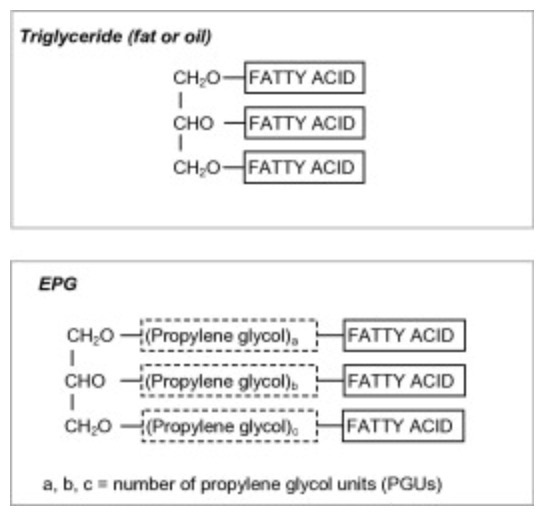
EPG made based on how much propylene glycol is attached, the prime selection for commercial use (and for safety testing) was based on three criteria: a solid state at body temperature to minimize negative gastrointestinal effects, amount of saturated fatty acids to reduce caloric availability, and the degree of propoxylation to prevent lipase digestion. Several studies were done on the safety of EPG, including but not limited to a tolerance study on dogs and rats, a few toxicity studies on rats, mice, dogs, and micro-pigs, and a human study on tolerance and effects on fat-soluble vitamins and other nutrients. The toxicity studies found that EPG passes through the GI tract and is largely unchanged, meaning toxicity is highly unlikely. The human study had found EPG had no effects on circulating vitamins A (retinol), E (a-tocopherol), or D2. However, they did see lower levels of vitamins A (b-carotene), and K1. Overall, with the projected consumer exposure for EPG (no greater than roughly 20g per day), it is not expected to have any significant effect on absorption of fat-soluble nutrients or the GI tract in general. Though EPG is proven to be GRAS (Generally Recognized as Safe), with the rise of calorie tracking and weight-loss focus on nutrition, there is something that needs to be said about how this is being marketed.
One detail about the Epogee website that I have left for this paragraph is one of their slogans, a sentence that echoes the decades of toxic diet culture and a prioritization of body image over health: “The Skinniest Fat on the Market.” Though they still discuss metabolic health and state it as their overall goal, Epogee clearly still has its roots in the world of “skinny” and “guilt-free” snacks, or “indulgences” as they say because heaven forbid you eat a cookie unless it has these claims. Also considering that David bars are primarily marketed towards gym enthusiasts and bodybuilders, a subculture that has been prone to eating disorders, I thought it would be necessary to look at what EPG and the products it will create may mean for diet culture. In an article from the Eating Disorder Space on the food industry’s current obsession with protein, Daisy Habib (RDN) discusses how this continuing trend of focusing on excessive protein intake and limiting caloric intake “can become another form of diet culture disguised as wellness.” She notes how this protein obsession can create even more stress around food, with people being worried about their foods not being considered to be high in protein, or believing it needs to be the primary nutrient in everything they consume, we already see this with gym influencers showing off their diets with ridiculously high amounts of protein. She points out social media specifically as they often claim high-protein as some sort of symbol of dietary excellence, often at the expense of other important nutrients, especially fibre. In actuality, most people do not need to worry about their protein intake if they are within their recommendations, unless they are athletes, older adults, or people recovering from illness, injuries, or eating disorders. Habib also mentions how diet culture has changed over the years and now instead of being told to just eat less, people are being told about the wonders of optimization, an idea that brands like David protein thrive off. When you look at an ingredient like EPG through the lens of diet culture, you can see how there is potential for the products to come from it may be used in a way that takes health away from nutrition and turns the focus to body image.
Esterified Propoxylated Glycerol (EPG) has been making waves in the industry of food technology and has made the David protein bar company a staple for gym rats across the US. Both for its resemblance to regular fats in foods and the monopoly that the David company now owns over it. Despite being Generally Considered as Safe (GRAS), there are still implications that EPG, especially when used in high-protein foods, can contribute to the growing issue of toxic diet culture. Personally, I think that EPG can be revolutionary for the world of food and nutrition, though I think that in the hands of a protein-focused company (especially with their business practiced that lead to their lawsuit) there is potential for negative impacts. I am intrigued to see what comes next for EPG and I hope it is used for good without taking us back to an era where fat was considered a dirty word.
References
Daisy Habib. (2026, June 24). The Rise of the Protein Obsession: How the High-Protein Diet Trend Is Fueling Diet Culture. The Eating Disorder Space. https://www.theeatingdisorderspace.com/post/the-rise-of-protein-obsession-how-the-high-protein-diet-trend-is-fueling-diet-culture
David H. Bechtel. (2014). Article series: Safety of esterified propoxylated glycerol (EPG), a nonabsorbable fat replacer. Regulatory Toxicology and Pharmacology, 70, 91–94. https://pdf.sciencedirectassets.com/272321/1-s2.0-S0273230014X00139/1-s2.0-S0273230014002852/main.
Elaine Watson. (n.d.). Exclusive: David Protein scales alt-fat EPG capacity, eyes CPG deals as CEO targets $300m revenues in 2026. AFN. AgFunderNewsletter. Retrieved https://agfundernews.com/exclusive-david-protein-scales-alt-fat-epg-capacity-eyes-cpg-deals-as-ceo-targets-300m-revenues-in-2026
Epogee - Where Health Meets Taste. (2023, May 11). Food Business Review, 14–15. https://www.foodbusinessreview.com/epogee
Our Story. (n.d.). David Protein. Retrieved https://davidprotein.com/pages/our-story
Surbhi Ashri & Dr. Neeta Bachheti Thapliyal. (n.d.). EPG: How a Decades-Old Fat Substitute Became a Modern Patent and Supply-Chain Battleground. Lexology. Retrieved https://www.lexology.com/library/detail.aspx?g=741040e3-4f74-4bb1-9907-50acfcf6f95b