Feeling Weaker? The Truth about Muscle Loss after 50
By Tanushaa Kanagasingam, University Representative for McGill University
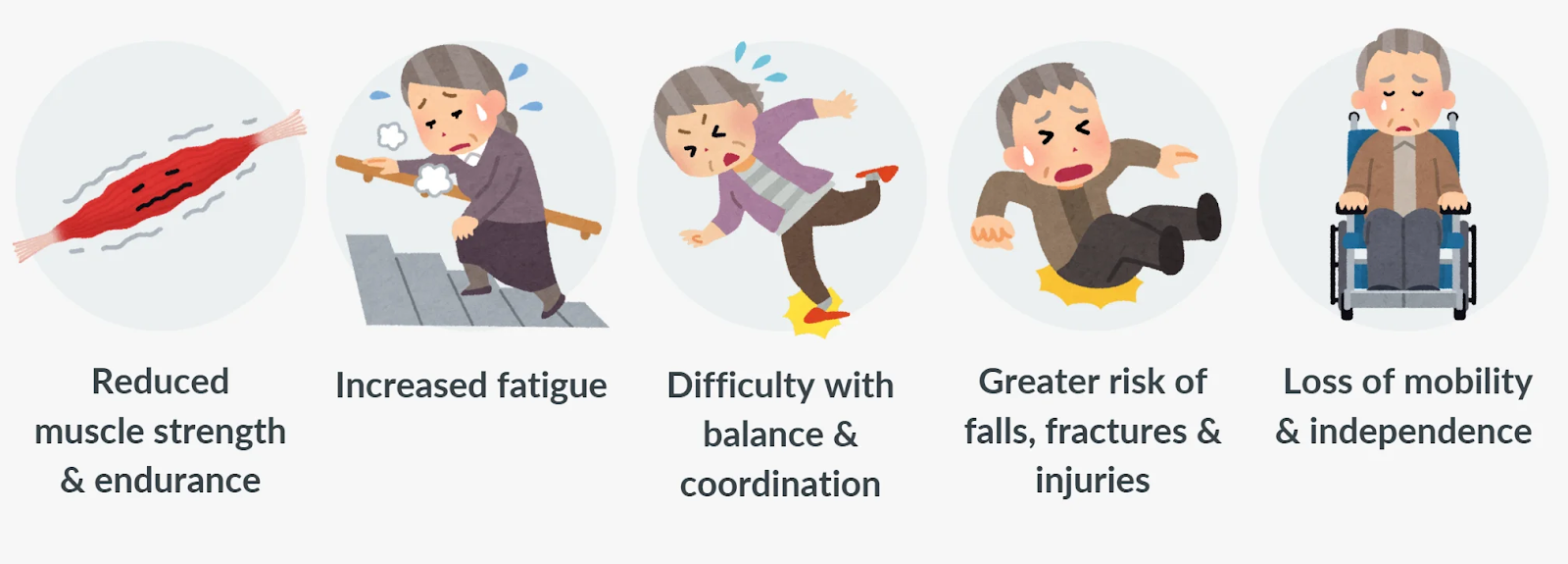
(InBody Asia, 2025)
Are you around the age of 50 and have been experiencing difficulties with daily tasks, such as standing up from a chair, carrying groceries, or simply walking? Well, if you do, you are in the right place to find the secret culprit within your body.
It is essential to first understand that muscles are an extremely important component of your body, helping to perform the daily tasks mentioned previously, allowing you to move, maintaining your posture and stabilising your joints. However, as we age, we gradually lose muscle mass, strength and function, reducing our ability to perform any tasks. Sarcopenia is exactly this process of involuntary muscle loss when aging but accelerated. It can greatly impact your quality of life by reducing your ability to perform daily tasks. In addition, it can lead to the loss of your independence and the need for long-term care. Sarcopenia affects your musculoskeletal system, the body’s support structure, by increasing the risk of fractures and falls. This could lead to hospitalizations and surgeries, which increase the risk of complications, including death in extreme cases (Cleveland Clinic, 2022b).
Some causes for sarcopenia include physical inactivity, obesity, malnutrition and some chronic diseases such as diabetes, mental health disorders and chronic kidney disease. Yet, the main cause remains age. In fact, as you age, your body undergoes certain changes that play a major role in developing sarcopenia (Cleveland Clinic, 2022b). For instance, your body doesn’t produce the same number of proteins your muscles need to grow. When this happens, your muscle cells get smaller. After age 30, you begin to lose as much as 3% to 5% per decade, and this becomes a significant loss at age 60, the group affected most by sarcopenia, when the rate increases as you get older. This is why it is important to look for early signs at the age of 50 (News In Health (NIH), 2025).
At the age of 50, you might want to look for some early signs to prevent the risk of developing sarcopenia and maintain a healthy body. The most common sign is muscle weakness, such as not being able to open a jar as you used to. Other signs include loss of stamina (getting tired easily), walking slowly, difficulties climbing stairs, poor balance and visibly smaller muscles (Cleveland Clinic, 2022b). If you do see those early signs or symptoms, I am glad to deliver you the news that sarcopenia can be reversible or significantly managed. It all comes down to these two methods of prevention: exercise and nutrition (Harvard Health Publishing, 2016).
According to studies, the ideal method to maintain and grow muscles is to exercise, especially through progressive resistance training. It is defined by gradually increasing the intensity of your workout through increasing weights, number of reps or sets. This way, muscles are constantly being challenged and promotes muscles to grow. For example, if an individual always does bicep curls with 2lbs, they will eventually find the exercise very easy, and that would not promote muscle growth since it is not challenging anything anymore. In fact, in a recent meta-analysis, 49 studies of men ages 50 to 83 who did progressive resistance training averaged a 2.4-pound increase in lean body mass after consistently working out with this new method (Harvard Health Publishing, 2016).
However, most of the gains would not be possible if there were no proper nutrition. In fact, protein-rich foods are equal to muscle foods. In your body, the protein in the food you consume is broken down into smaller pieces called amino acids, which are then used to build muscles. Older adults experience anabolic resistance, defined as the decreased ability to break down and create proteins. This makes older adults have the need to consume even more protein in their diet to maintain muscle mass. It is recommended to consume around 1-1.3 grams per body weight in kg. This is a high amount compared with the average diet, but there are many ways to get the extra protein you need. Animal sources (meat, eggs, and milk) are considered the best, as they provide the proper ratios of all the essential amino acids. For vegetarians, soy products such as tofu are ideal and provide the same benefits or more. In addition, although food sources are better, if you really struggle with protein intake, you could resort to protein powders that offer around 30 g per scoop and can be added to desired everyday meals (Harvard Health Publishing, 2016).
Sarcopenia is not an inevitable hole as you age, but a condition that you could fight or prevent through progressive resistance training and adequate protein intake. It is not just about building muscles, but about preserving your ability to live life on your own terms.
References
Cleveland Clinic. (2022a). Muscle atrophy: Causes, symptoms & treatment. Cleveland Clinic.
https://my.clevelandclinic.org/health/diseases/22310-muscle-atrophy
Cleveland Clinic. (2022b). Sarcopenia (Muscle Loss): Symptoms & Causes. Cleveland Clinic.
https://my.clevelandclinic.org/health/diseases/23167-sarcopenia
Cleveland Clinic. (2022c, September 1). Bone Fractures. Cleveland Clinic; Cleveland Clinic.
https://my.clevelandclinic.org/health/diseases/15241-bone-fractures
Harvard Health Publishing. (2016, February 19). Preserve your muscle mass - Harvard Health. Harvard
Health. https://www.health.harvard.edu/healthy-aging-and-longevity/preserve-your-muscle-mass
InBody Asia. (2025, July 9). Poor Nutrition: The Silent Accelerator of Sarcopenia. InBody Asia.
https://inbodyasia.com/blog/poor-nutrition-the-silent-accelerator-of-sarcopenia-you-shouldnt-ignore/
News In Health (NIH). (2025, April). Slowing Sarcopenia. NIH News in Health.
https://newsinhealth.nih.gov/2025/04/slowing-sarcopenia
Paluch, A. E., Boyer, W. R., Franklin, B. A., Laddu, D., Lobelo, F., Lee, D., McDermott, M. M., Swift, D.
L., Webel, A. R., & Lane, A. (2023). Resistance exercise training in individuals with and without cardiovascular disease: 2023 update: A scientific statement from the American Heart Association. Circulation, 149(3). https://doi.org/10.1161/cir.0000000000001189
SingleCare. (2023, November 13). What are high-protein foods? The Checkup; SingleCare.
https://www.singlecare.com/blog/high-protein-foods/
Von Haehling, S., Morley, J. E., & Anker, S. D. (2010). An overview of sarcopenia: facts and numbers on
prevalence and clinical impact. Journal of Cachexia, Sarcopenia and Muscle, 1(2), 129–133. https://doi.org/10.1007/s13539-010-0014-2